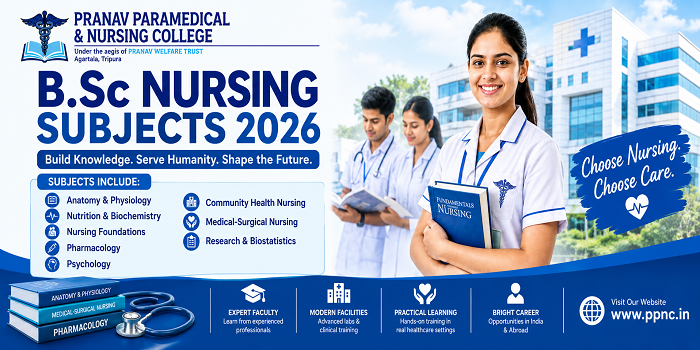
B.Sc Nursing 1st Year Subjects
The above subjects become the foundation for other subjects in the first year of the B.Sc Nursing Program. These include subjects such as Anatomy, Physiology, Biochemistry, Basics of Nursing, Nutrition, Psychology, and other basic subjects that one needs to study while in a nursing education program. These subjects help in understanding the anatomy and physiology of the human body as well as the basic health requirements of nursing.
Basics of nursing become very useful in that it becomes an opportunity to learn skills such as assessing patients, hygienic practices, measuring vital signs, comfort care, communication, and documenting, among other things. Subjects such as Anatomy and Physiology will be helpful in understanding the body processes in future classes in the nursing program.
B.Sc Nursing 2nd Year Subjects
The subjects chosen by the students who are in the second year B.Sc Nursing class would have a clinical feel to them. Some of the important subjects that could be present are Medical-Surgical Nursing, Pharmacology, Pathology, Microbiology, Sociology, and other nursing-related communication subjects as per the course curriculum of the university.
Medical-Surgical Nursing involves caring for patients with varying health issues. Pharmacology deals with drugs and their action, dosage, and side effects. Diseases can be studied through pathology.
B.Sc Nursing 3rd Year Subjects
The topics covered in the third year of B.Sc Nursing are generally more specific as far as nursing and public health are concerned. These topics include Child Health Nursing, Mental Health Nursing, Community Health Nursing, and nursing research topics.
Child Health Nursing deals with the health issues of infants, children, and adolescents. The main emphasis is on health issues relating to the development of these age groups. Mental Health Nursing provides information regarding mental disorders and communication. Community Health Nursing includes health promotion and disease prevention.
B.Sc Nursing 4th Year Subjects
Some of the topics covered by the course outline of BSc Nursing fourth year that contribute to the widened scope of career opportunities include:
- Midwifery and Obstetric Nursing,
- Community Health Nursing,
- Nursing Research and Statistics,
- Nursing Management and Education, and also internship or extended clinical practice.
Midwifery is associated with issues such as pregnancy, birth, the postpartum stage, and maternal and child health. Management and education involve issues such as leadership, delegation, supervision an, and teaching of nursing care services.
B.Sc Nursing Theory and Practical Subjects
The curriculum of the BSc nursing course does not rely only on the examinations carried out in the classroom. The theory classes aim to deliver scientific and professional information, while the practical classes help the students develop clinical skills. Practical training is essential as nurses have to be able to apply their theoretical knowledge in practice.
Examples of such activities include laboratory classes, demonstrations, simulations, field work, cases, and patient care. Practical training is essential as nurses have to be able to apply their theoretical knowledge in practice.
Which B.Sc Nursing Subjects Are Important for Clinical Practice?
There is a reason why each field is chosen for inclusion in the course, but there are some fields that have an incredibly strong association with patient care practice. Adult Nursing is associated with learning about adult patients, and the field of Midwifery deals with mothers and babies. Pharmacology studies become essential for proper drug management. Child Health Nursing and Mental Health Nursing deal with specialized patient care concerns.
It is important to focus on concepts and communications within the profession.
Is B.Sc Nursing Difficult to Study?
B.Sc Nursing studies can be considered difficult owing to the combination of science and nursing theories, and many other factors like practical experience and exams. However, it is also fortunate that if one studies well, he/she will not find it difficult at all. Some tips on how one can study include revising lessons, writing concise notes, understanding theories instead of cramming them, and performing procedures.
Effective time management is crucial in such programs.
How Can Students Prepare for B.Sc Nursing Subjects?
First of all, you must acquaint yourself with the syllabus and semester-wise requirements available in your college/university. You can divide big chapters into smaller modules and then revise those modules again and again. Use good quality books and other academic resources, and clear your confusion about difficult topics by consulting experts.
Use techniques like diagramming, concept mapping, and case-based problems that can enhance your memory power. Most importantly, stick to the guidelines of the institute.
Why Choose a Structured Nursing Education?
Nursing education must go beyond the skills acquired through examinations. Competence should be cultivated so that the nurses can act responsibly and communicate effectively, identify patients’ needs, and provide quality care in the healthcare teams. The updated INC curriculum emphasizes competence, outcomes, communication, teamwork, technology, ethics, and evidence-based practice.
Pranav Paramedical & Nursing College is an institution where nursing education can be studied from both the academic and practical perspectives. Students must evaluate the admission requirements, curriculum, infrastructure, and clinical experience before making the academic decision.
Conclusion
Nursing Education should not stop at skills learned by taking examinations. The competence of the nurses should be developed to ensure that the nurses act responsibly and communicate effectively, determine the needs of the patients, and offer quality care within the healthcare team. The new INC curriculum focuses on competence, outcomes, communication, teamwork, technology, ethics, and evidence-based practice.
Pranav Paramedical & Nursing College is one place wherein nursing education can be examined both academically and practically. Students should examine the admission requirements, curriculum, facilities, and clinical exposure before making their academic decisions.