
Blog Details
- Home
- Nursing Interview Questions & Tips for Freshers – Copy
- August 29, 2026
- comments (0)
- 9 min read
Nursing Interview Questions & Tips for Freshers – Copy
B.Sc Nursing is a professional undergraduate course that involves academic education, practical training, clinical experience, communication, and a patient-centered approach. For new entrants in the first year, knowing about the B.Sc Nursing syllabus will enable them to prepare for the course and get the necessary background required for higher nursing courses.
A revised syllabus and curriculum for the course has been brought out by the Indian Nursing Council (INC), and some of the publications of the council are the Revised B.Sc(N) Syllabus 2020. Some other notifications related to the course have been issued later by the council, and therefore, students should always compare the syllabus guide with the curriculum prescribed by their respective university.
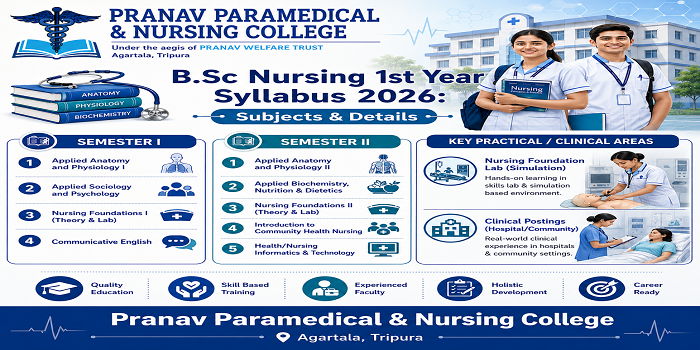
B.Sc Nursing 1st Year Syllabus 2026 – Overview
During the first year of B.Sc Nursing, there will be chances for learners to acquire knowledge about basic sciences, behavioral sciences, fundamentals of nursing, communication, and professional learning through lectures, demonstrations, laboratory sessions, assignment writing, skills acquisition, and practical clinical experiences.
The learning program will be competence-based and outcome-oriented. The program also covers topics such as communication, teamwork, ethics, safety, evidence-based practice, and technology in the nursing profession. The first year of learning experience will therefore be focused on more than just reading and acquiring knowledge from books, but on implementing the theory into practice.
B.Sc Nursing 1st Year Subjects List
However, the order of subjects may vary between different universities because different universities have the right to organize their classes, semesters, exams, and programs according to the curricula approved for them. The first-year subjects include:
- Anatomy & Physiology
- Microbiology
- Psychology
- Sociology
- Fundamentals of Nursing
- Dietetics & Nutrition
- Biochemistry
- English/Communication studies
- First Aid & Basic Nursing Techniques
- Professional Clinical Studies
Your university timetable, syllabus, academic calendar, and exam schedule shall serve as the ultimate guide.
B.Sc Nursing 1st Year Subject-Wise Syllabus
Anatomy
Anatomy exposes students to the body structures of humans. Knowing the structures of the body helps nursing students to recognize any deviation from normality in the health status of the patient.
Physiology
Physiology enables us to comprehend the way the human body works. Physiology is defined as the study of biological functions like circulation, respiration, digestion, kidney function, nerve function, hormone control, and reproduction.
Microbiology
Microbiology covers micro-organisms and their association with disease. The topics include bacteria, viruses, fungi, parasites, modes of infection, sterilization, disinfection, and basic infection control methods.
Psychology
Psychology is a study that enables students to learn about behaviors, emotions, personality, learning, motivation, development, and reactions to stress. For nursing students, such knowledge can be employed in order to enhance communication skills and provide proper individual care.
Sociology
Sociology is concerned with individuals who are part of their families and society. Sociology includes topics like culture, socialization, family systems, social problems, and the relationship between society and health. This class will allow you to learn how the social world around you can affect your health behaviors and access to healthcare.
Nursing Foundation
“Nursing Foundation” is one of the most crucial topics covered during the first year of training because it covers the basics of nursing. Topics such as the nursing process, patient assessment, hygiene, comfort, positioning, vital signs, procedure skills, documentation, communication, and safety of patients are some of the topics covered.
Nutrition and Biochemistry
Nutrition provides details on nutrients, proper nutrition, nutritional treatment of eating disorders, nutritional assessment, and the significance of nutrition in the health and healing process. The biochemistry subject provides students with basic knowledge of chemistry in relation to how the body works, for example, carbohydrates, proteins, lipids, enzymes, vitamins, minerals, and metabolism.
B.Sc Nursing 1st Year Practical Subjects
Practice learning is among the fundamental elements in the educational process for nurses. In such ways as demonstrations, practical training, laboratory work, simulations, and clinical practice, the learners acquire knowledge about how to conduct certain procedures. As per the university and the syllabus, practice learning may include washing hands, taking vital signs, making beds, positioning the patient, giving hygiene care, assessment, communication, documentation, first aid, and other fundamental nursing skills.
In general, practice learning consists of learning how to conduct certain procedures professionally.
B.Sc Nursing 1st Year Theory and Practical Exam Pattern
Normally, assessment includes internal assessment and examination by the university or council, depending on the type of curriculum that is used. Exam schemes and guidelines are released by the INC, while assessment guidelines are done by universities according to the set guidelines.
The mode of assessment may include exams, practicals, clinical performance, assignments, recordings, presentations, and internal assessment, among others. For instance, exam schemes for first-year subjects of the INC include internal assessment and examination by the board or council. It is important, therefore, for the students to look at the notification of the university’s exam rather than following an old-fashioned pattern.
How to Prepare for B.Sc Nursing 1st Year Exams
Firstly, go through the syllabus and divide every subject into different units. Plan your revision week-wise and revise every hard topic regularly rather than postponing revision till exams.
Here are some good tips that every student should follow:
- Learn the concepts before memorizing the definitions.
- Short notes should be made; drawings, tables, and flow charts can be made.
- Practice diagrams and technical language in Anatomy.
- Revision of nursing procedures step by step.
- Relation between theories and practical applications.
- Doing past question papers as soon as they become available.
- The practical record should be up to date.
- If anything is not clear, then ask the teachers.
- Schedule revision and adequate sleep.
For Anatomy and Physiology, you should use diagrams and revision from time to time. For the Nursing Foundation, you should focus on the reason and sequence of procedures.
Importance of B.Sc Nursing 1st Year Subjects
The first year will lay the foundation for subsequent studies in nursing. Basic sciences will help in understanding the body, whereas behavioral sciences will assist in communication and interaction. The subject entitled Nursing Foundation will introduce the fundamentals of nursing practice. These subjects will lay the required foundation for subsequent study of medical-surgical nursing, child health nursing, mental health nursing, community health nursing, and maternal health nursing.
The better the foundation, the sounder the reasoning process. If the students have an adequate knowledge of normal anatomy and physiology of the body, they will be able to recognize any deviations from the normal.
B.Sc Nursing Syllabus: What Students Should Know
Those who are in search of the syllabus of B.Sc Nursing should be careful while browsing through certain websites providing outdated syllabuses of subjects. INC has provided the Revised B.Sc(N) Syllabus 2020 in its list of publications and has announced further notifications on the course. The syllabus, as mentioned by the council, involves a total of eight semesters in four years, inclusive of an internship.
Given the fact that different universities have released their own academic schedules, exam timetables, course structures, etc., it becomes important to get hold of the latest information in relation to the same, especially for the year 2026.
Those who are interested in pursuing studies in nursing in Tripura may consider Pranav Paramedical & Nursing College as an ideal choice for the purpose.
Conclusion
The syllabus for 1st Year B.Sc Nursing serves as the foundation for knowledge of science, nursing skills, communication, professional behavior, and patient safety. It needs to be remembered here that the 1st year is not only meant to obtain good marks, but it should be a mixture of theoretical and practical aspects of study. Proper knowledge, skill practice, record keeping, and regular revisions would prove helpful in creating a good base for future years.
Always go through the current syllabus as well as the examination guidelines of the respective university.
Frequently Asked Questions
1.How many subjects are there in B.Sc Nursing 1st year?
There may be variation in the number and grouping of subjects according to the particular university and course system. Students need to consult the latest syllabus from their university.
2. Which is the most important subject in B.Sc Nursing 1st year?
The foundation of Nursing is especially crucial since it builds up the fundamentals of nursing knowledge and practice. Nevertheless, all subjects studied in the first year help form this foundation.
3. Does B.Sc Nursing 1st year include practical training?
Yes. Skills training is a key component of nursing education, although there may be variations in what those skills are and how they are tested.
4.Is B.Sc Nursing 1st year difficult?
The first year can feel challenging because students encounter medical terminology, scientific subjects, nursing procedures, and new academic expectations. Regular study, practice, and guidance can make the transition easier.
5.Where can students check the official B.Sc Nursing syllabus?
The students should look into the notices and syllabuses that have been issued by the Indian Nursing Council, in addition to the university or other nursing authority notices.

Pranav Paramedical


Working Time
- Mon - Sat : 09:00 AM - 06:00 PM
- Damdamia, Oppo. CJ Resorts, Debendra Chandra Nagar, P.O.- Lembucherra, P.S.- Lefunga, Agartala, West Tripura, Tripura- 799210.
Copyright © 2026, PPNC. All Rights Reserved.
WhatsApp us