
Blog Details
- Home
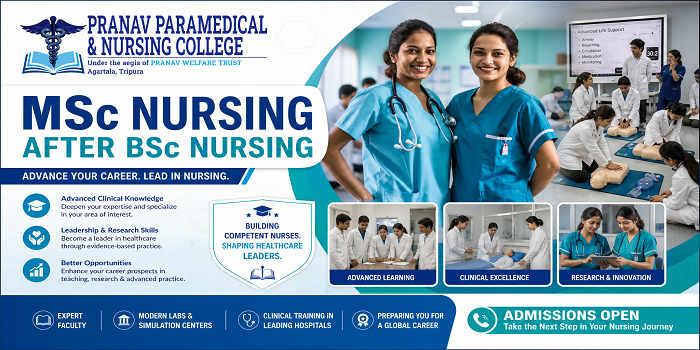
- MSc Nursing After BSc Nursing: Eligibility, Admission, Fees & Career
- August 25, 2026
- comments (0)
- 9 min read
MSc Nursing After BSc Nursing: Eligibility, Admission, Fees & Career
MSc Nursing is a graduate program that targets those who have already completed their BSc Nursing program and are interested in developing clinical skills, leadership qualities, as well as participating in educational, administrative, research, or advanced nursing practices. It is quite logical that a number of students choose to pursue further education through an MSc Nursing program immediately after finishing their BSc Nursing program, since they can make full use of their acquired knowledge and experience.
Nevertheless, students must bear in mind that admission criteria, tests, registration process, tuition fees, and specialties may differ depending on universities, states, and colleges. Therefore, an applicant must consult the latest prospectus and admission announcement.
Can you do an MSc in Nursing after a BSc in Nursing?
Yes, the aspirants of BSc Nursing can join the MSc Nursing course by meeting the mentioned eligibility criteria of the respective university.
The purpose of this course is to attract those candidates who have nursing education and also the required experience, if any. It is essential to know all the eligibility criteria before joining a specific college.
MSc Nursing Eligibility After BSc Nursing
The first thing that students need to take into account while studying the MSc Nursing program is the eligibility criteria. These criteria can vary; however, one of them could be that the applicant must either possess a BSc Nursing degree or its equivalent.
The institutions might also ask for the minimum percentage of marks that the applicant must secure in the qualifying examination; there are also many other criteria of eligibility, such as the practical experience of the applicant. In addition to this, the applicants need to know whether it is necessary for the institution that the candidate must be registered in the concerned nursing council.
Since policies can vary, it is suggested that the applicants visit the official notice on the matter.
MSc Nursing Course Duration
MSc Nursing program in India is generally organized as a two-year course, but the students must check the duration of the course from the university they wish to join. The course generally includes theoretical study, practical training, research, seminars, assignments, and more.
The academic structure of the course differs among universities.
MSc Nursing Admission Process
The process of admission normally starts with checking eligibility and finding out which colleges provide the specialty being sought. The students can fill in the online or offline application form, present their educational and registration papers, and attend the entrance test, if any.
Depending on the college, selection could be done based on entrance test performance, academic performance, counseling, or a combination of all these. The selected students will need to verify their documents and pay the specified admission fees.
The students who want to get MSc Nursing admission after BSc Nursing have to be prepared with their certificates, registration papers, pictures, identity papers, and other documents as well.
MSc Nursing Entrance Exam
An entrance exam might be one of the ways by which the selection process is done by certain institutions. The pattern of the test differs from institution to institution. It becomes necessary for the candidate to prepare for subjects like nursing subjects, general knowledge, research subjects, etc., according to the needs of that particular institution.
The candidate must not prepare for the test on the basis of any assumptions, but as per the latest syllabus and notification.
MSc Nursing Specializations
What is especially valuable in MSc Nursing studies is the chance to become a specialist in a certain sphere of nursing. Medical-Surgical Nursing, Child Health Nursing, Community Health Nursing, Mental Health Nursing, and Obstetric and Gynecological Nursing are among these spheres.
There are many reasons why some specializations may not be available in certain educational institutions – these include the institution itself, the staff there, the infrastructure of the university, etc. It is important for students to make a decision about the specialization depending on their preferences and future career.
MSc Nursing Syllabus
In most cases, the syllabus includes topics that are taught to undergraduate students of nursing. This includes advanced practice of nursing, nursing education, nursing management, research methods, statistics, community health nursing, special topics, and clinicals.
Research is an integral part of graduate study. The student will be required to develop a topic for nursing research, conduct a literature review, design a research proposal, gather and analyze data, and eventually present the results in line with the university requirements. It is worth mentioning that the syllabus varies from one institution to another.
MSc Nursing Fees in India
There is a wide range of variation regarding the cost of pursuing an MSc in Nursing in India. The variations will depend on several factors, including the educational institution, the geographical location, the infrastructure of the institution, the syllabus of the course, and the mode of admission into the institution.
It should be noted that there are a number of costs that should be holistically looked at regarding the cost of education, which include costs of examinations, registration fees, costs of boarding, costs of food, textbooks, uniforms, practicals, transport, among others.
Career Opportunities After MSc Nursing
The career prospects that an MSc Nursing offers can provide a variety of career paths within the scope of the services offered by the clinics, education, administration, research, and public health. In view of the qualifications and the requirements of recruitment, one can make the decision to choose a career in the field of nursing education, clinical nursing, nursing administration, research, and public health.
Some may prefer a teaching career in a nursing college, while others opt for a hospital career. It is all dependent upon various factors like registration, experience, skills, and recruitment criteria.
MSc Nursing Salary in India
The salary of an MSc Nursing in India does not have an exact amount. It depends on various factors such as qualification, specialization, experience, placement, designation, etc.
As an example, there are freshers who may earn in various salary brackets, while those who specialize in a certain field will have greater chances of earning more.
MSc Nursing vs Working After BSc Nursing
After completion of the BSc Nursing program, students have the choice either to pursue further studies after BSc Nursing or to join the profession. Work will prove beneficial for the reason that it provides practical experience and financial freedom to the students, among many others. On the other hand, pursuing further studies would provide the students with greater knowledge in the subject and preparation for future careers.
It all depends upon the particular cases because one group of students may choose to pursue further studies while another may go for work.
Is an MSc in Nursing a Good Option After a BSc in Nursing?
For those students who seek knowledge about nursing in greater depth, an MSc in Nursing may turn out to be a good choice. But this choice must be based on career objectives, not the misconception that postgraduate degrees are better than any other by default.
Before choosing an institution for MSc Nursing studies, students need to make sure that they consider curricula, specializations, accreditation, clinical practice opportunities, professors, cost, location, admission criteria, and career prospects after graduating. Students of Pranav Paramedical & Nursing College will find it helpful when planning their nursing career path.
What are the other courses after a BSc in Nursing?
Considering the individual’s career goals and qualifications, he or she can choose postgraduate programs in nursing, health care management, public health, nursing education, research-based studies, and professional certification.
This choice will depend on whether he or she wants to continue being a practitioner or go into education, management, research, or another area of health care practice. Comparison of the program results, qualifications, time required, expenses, and career opportunities will assist in making the right choice.
Final Thoughts on MSc Nursing After BSc Nursing
Enrolment in postgraduate programs in nursing is a crucial career move. MSc Nursing will be the way through which professional expertise, specialization, and preparation for certain career moves in the field of nursing will be acquired in regard to clinical practice, education, administration, research, and community health.
It will be essential to have details about such things as entry criteria, admission procedures, entry requirements, costs, accreditation, and syllabus from the educational institution to help in making an informed decision.
The nursing professional needs to understand that the education process does not end at the undergraduate level.
Frequently Asked Questions
1. Can I do MSc Nursing after BSc Nursing?
Yes, BSc Nursing graduates can generally pursue MSc Nursing if they meet the eligibility and registration requirements of the respective university or institution.
2. What is the duration of MSc Nursing after BSc Nursing?
MSc Nursing is generally a two-year postgraduate programme in India. However, students should verify the current duration with their chosen university.
3. What is the eligibility for MSc Nursing after BSc Nursing?
Eligibility may include a recognized BSc Nursing degree, minimum qualifying marks, professional nursing registration, and other requirements specified by the institution.
4. Is an entrance exam required for MSc Nursing?
Some universities and institutions conduct an entrance examination, while others may use merit-based selection. Requirements vary by institution.
5. What are the specializations available in MSc Nursing?
Common specializations include Medical-Surgical Nursing, Child Health Nursing, Community Health Nursing, Mental Health Nursing, and Obstetric and Gynaecological Nursing.
6. What are the career options after MSc Nursing?
Graduates can explore opportunities in clinical nursing, nursing education, administration, research, community health, and healthcare services, depending on their qualifications and employer requirements.
7. Is MSc Nursing a good option after BSc Nursing?
MSc Nursing can be a suitable option for graduates seeking advanced nursing knowledge, specialization, teaching, research, leadership, or academic career opportunities.

Pranav Paramedical


Working Time
- Mon - Sat : 09:00 AM - 06:00 PM
- Damdamia, Oppo. CJ Resorts, Debendra Chandra Nagar, P.O.- Lembucherra, P.S.- Lefunga, Agartala, West Tripura, Tripura- 799210.
Copyright © 2026, PPNC. All Rights Reserved.
WhatsApp us