B Sc Nursing Eligibility Criteria
Before applying, it’s worth getting clear on the b sc nursing eligibility criteria, since requirements shift slightly between states and institutions.
Academic Qualification
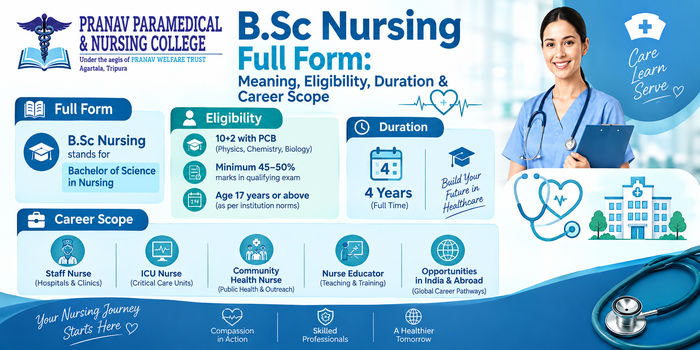
Candidates need to have completed 12th grade with Physics, Chemistry, and Biology (PCB), typically with a minimum aggregate of 45–50%, depending on the college.
Age Limit
Most institutions set the minimum age at 17 years at the time of admission. Upper age limits vary by state, so it’s worth checking current-year notifications rather than relying on older information.
Entrance Exams
Many states have started taking the NEET exam to get into B Sc Nursing, while there are some other entry routes to consider, such as AIIMS Nursing and JIPMER. There are even some colleges that conduct their own entrance exams, so it is best to confirm this early on.
B Sc Nursing Course Duration & Structure
The academic course lasts for a period of four years, covering eight semesters, with six months for internship, taking a total period of four and a half years. Every year covers classroom teaching, laboratory work, and clinical rotation through various departments such as ICU, emergency room, pediatric care, obstetrics, and community health centers. The internship year is where confidence is gained because it covers only clinical work as compared to classroom studies.
B Sc Nursing Syllabus Overview
The b sc nursing syllabus builds progressively across the four years:
- Year 1: Anatomy, Physiology, Nutrition, Psychology, and Fundamentals of Nursing
- Year 2: Medical-Surgical Nursing, Microbiology, Pharmacology, and Communication Skills
- Year 3: Child Health Nursing, Mental Health Nursing, and Community Health Nursing
- Year 4: Midwifery, Nursing Management, and Research Methodology, alongside intensive clinical internship
By the final year, students are handling real patient care responsibilities under supervision — not just studying theory.
B Sc Nursing vs GNM vs Post Basic B Sc Nursing
This comparison comes up constantly, so here it is in plain terms: GNM takes 3.5 years and results in a diploma. B Sc Nursing takes 4 years and results in a full degree. Post Basic B Sc Nursing is a 2-year bridge program specifically for GNM-qualified nurses who want to upgrade to a degree.
Course | Duration | Level |
GNM (General Nursing
and Midwifery) | 3.5 years | Diploma |
B Sc Nursing | 4 years | Undergraduate Degree |
Post Basic B Sc
Nursing | 2 years | Degree (for GNM nurses) |
The GNM full form is General Nursing and Midwifery. And the post basic B Sc Nursing full form is Bachelor of Science in Nursing — just delivered as a shorter bridge course for nurses who already hold a GNM diploma and want the degree without restarting from scratch.
B Sc Nursing Course Fees and College Selection
B Sc nursing course fees vary sharply by institution type. Government colleges typically charge somewhere between ₹10,000 and ₹50,000 a year, private colleges range from ₹50,000 to ₹2,50,000 annually, and deemed universities can run higher still. Over four years, total costs can range anywhere from around ₹40,000 at the low end to several lakhs at private institutions — so it’s worth budgeting for hostel, uniform, and clinical-practical costs on top of tuition.
When shortlisting b sc nursing colleges in India, look past brand recognition and check clinical tie-ups with hospitals, faculty qualifications, infrastructure, and actual placement track record — these affect the quality of your training far more than reputation alone.
B Sc Nursing Career Scope & Salary
Nursing remains one of the most stable, consistently in-demand careers in India’s healthcare sector. Graduates typically start as staff nurses or junior nurses before moving into ICU nursing, ward management, community health nursing, or teaching roles with experience.
On b sc nursing salary in India, fresh graduates typically start between ₹2.5 and ₹4.5 LPA, depending on the hospital type and city. With three to seven years of experience, this usually climbs to ₹4.5–8 LPA in roles like ICU nurse or ward manager. At the senior level — eight-plus years, in roles like nursing superintendent or hospital administrator — earnings often reach ₹8–15 LPA or more. Nurses who move abroad, particularly to the UAE, UK, Canada, or Australia, frequently earn significantly more, though that path usually requires additional certification and licensing exams specific to the destination country.
How to Apply for B Sc Nursing
Once you’ve confirmed eligibility and shortlisted colleges, the process generally looks like this:
- Check whether your target state or college requires NEET, or runs a separate entrance exam.
- Submit your application within the notified window, along with academic documents.
- Appear for the entrance exam (where applicable) and wait for the merit list or counseling
round. - Complete document verification and fee payment to lock in your seat.
At Pranav Paramedical & Nursing College, our admissions team walks students through each of these steps individually rather than leaving them to figure it out from a checklist. If you’re weighing your options for this admission cycle, reaching out early gives you a clearer picture of seat availability, entrance requirements, and fee structure specific to your situation.
Is B Sc Nursing Right for You?
This is only the beginning of the entire name – Bachelor of Science in Nursing. But the key lies in choosing the right college or university, understanding the entry requirements well in advance, and also being aware of what opportunities this course will provide you with. If you are looking around for more information about BSc Nursing, you can contact our admissions office at Pranav Paramedical & Nursing College.