
Blog Details
- Home
- BSc Nursing Salary in India: State-Wise Breakdown (Govt vs Private)
- September 23, 2026
- comments (0)
- 7 min read
BSc Nursing Salary in India: State-Wise Breakdown (Govt vs Private)
Reviewed by the Placement Team, Pranav Paramedical & Nursing College | Last updated: September 2026
Quick Answer
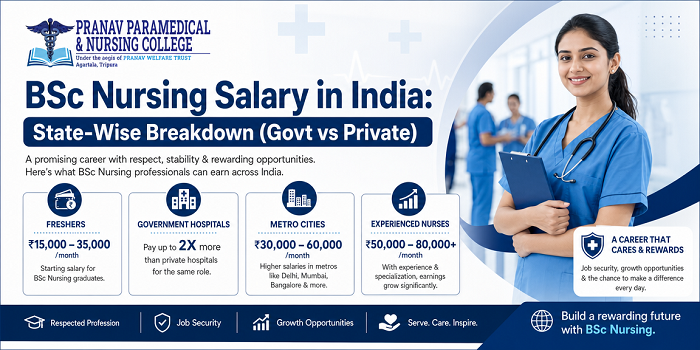
BSc Nursing salary in India typically ranges from ₹15,000–₹35,000 per month for freshers and ₹50,000–₹80,000 per month for experienced nurses. Government hospitals usually offer a higher starting salary along with job security and pension benefits, while private hospitals — especially corporate chains — tend to offer faster salary growth once you gain experience or specialise. Delhi, Maharashtra, and Karnataka generally pay the highest, while North Eastern and smaller states tend to be on the lower end, though remote-area allowances often close some of that gap.
If there’s one question every nursing student asks before they even finish their degree, it’s this — what will I actually earn once I start working? At Pranav Paramedical & Nursing College, we hear this almost every week, from students, from parents, sometimes even from working nurses trying to figure out if it’s time to switch cities or switch sectors. Over the last several placement cycles, our placement team has tracked hiring trends across more than 40 partner hospitals, and this article is built on that pattern — not just numbers pulled from a generic list.
So instead of giving you another vague “salary varies” answer, here’s a realistic, state-wise picture of what a BSc nursing salary in India actually looks like today — government and private, entry-level and experienced.If there’s one question every nursing student asks before they even finish their degree, it’s this — what will I actually earn once I start working? At Pranav Paramedical & Nursing College, we hear this almost every week, from students, from parents, sometimes even from working nurses trying to figure out if it’s time to switch cities or switch sectors. Over the last several placement cycles, our placement team has tracked hiring trends across more than 40 partner hospitals, and this article is built on that pattern — not just numbers pulled from a generic list.
What Does a Fresher Actually Earn?
Let’s start with the number everyone wants first. A fresh BSc nursing graduate typically starts somewhere between ₹15,000 and ₹35,000 a month. That’s a wide range, and there’s a reason for it — it depends heavily on whether you land a government post or a private one, which state you’re in, and whether you’re working in a metro city or a smaller town. This is your BSc nursing fresher salary, and honestly, it’s the number that shapes most of the early career decisions students make.
Once you cross three to five years of experience, that figure usually moves up to ₹35,000–₹50,000 a month. Push past six or seven years, especially if you’ve specialised in something like ICU or critical care, and ₹60,000–₹80,000 a month isn’t unusual.
Government vs Private — Does Private Really Pay Less?
This is probably the most common myth we come across, so let’s clear it up properly.
At the entry level, yes — government hospitals usually pay a little more than private ones. That’s because government salaries follow a fixed pay matrix with a guaranteed minimum, while private hospitals, especially smaller ones, have more room to offer a lower starting package.
But here’s what most people don’t realise — that gap doesn’t stay the same forever. Once you gain a few years of experience or pick up a specialisation like ICU, OT, or critical care, private hospitals — particularly the big corporate chains like Apollo, Fortis, Max, or Manipal — often match or even beat government pay. They tend to reward skill and performance faster than government structures do.
So the real picture is this: government salary grows slowly but predictably, with fixed increments, DA revisions, and pension benefits adding real value over time even if the monthly number looks modest. Private salary can grow much faster, through bonuses, night allowances, and quicker promotions, but there’s no fixed scale protecting you if things don’t work out. Neither one is simply “better” — it depends on whether you value stability or faster early growth.
(Related read: GNM vs BSc Nursing — Which One Should You Choose?)
State-Wise BSc Nursing Salary Breakdown
Here’s the full breakdown, entry-level and experienced, government and private, across every state and union territory.
State/UT | Govt Entry-Level | Govt Experienced | Private Entry-Level | Private Experienced |
Delhi | ₹30,000 – 38,000 | ₹45,000 – 60,000 | ₹20,000 – 28,000 | ₹35,000 – 45,000 |
Maharashtra | ₹28,000 – 35,000 | ₹42,000 – 55,000 | ₹20,000 – 27,000 | ₹33,000 – 45,000 |
Karnataka | ₹26,000 – 33,000 | ₹38,000 – 50,000 | ₹18,000 – 25,000 | ₹30,000 – 40,000 |
Tamil Nadu | ₹30,000 – 36,000 | ₹38,000 – 45,000 | ₹16,000 – 22,000 | ₹28,000 – 40,000 |
Kerala | ₹26,000 – 32,000 | ₹38,000 – 48,000 | ₹16,000 – 22,000 | ₹28,000 – 38,000 |
Telangana | ₹25,000 – 31,000 | ₹35,000 – 45,000 | ₹16,000 – 22,000 | ₹26,000 – 35,000 |
Andhra Pradesh | ₹22,000 – 28,000 | ₹32,000 – 42,000 | ₹15,000 – 20,000 | ₹24,000 – 32,000 |
Gujarat | ₹25,000 – 31,000 | ₹35,000 – 45,000 | ₹17,000 – 23,000 | ₹26,000 – 35,000 |
Rajasthan | ₹22,000 – 27,000 | ₹30,000 – 40,000 | ₹14,000 – 19,000 | ₹22,000 – 30,000 |
Punjab | ₹23,000 – 28,000 | ₹32,000 – 42,000 | ₹15,000 – 20,000 | ₹24,000 – 32,000 |
Haryana | ₹23,000 – 29,000 | ₹33,000 – 43,000 | ₹15,000 – 20,000 | ₹25,000 – 33,000 |
Uttar Pradesh | ₹20,000 – 25,000 | ₹28,000 – 38,000 | ₹13,000 – 18,000 | ₹20,000 – 28,000 |
Madhya Pradesh | ₹19,000 – 24,000 | ₹27,000 – 36,000 | ₹12,000 – 17,000 | ₹19,000 – 27,000 |
West Bengal | ₹20,000 – 25,000 | ₹28,000 – 38,000 | ₹13,000 – 18,000 | ₹20,000 – 28,000 |
Bihar | ₹18,000 – 23,000 | ₹26,000 – 35,000 | ₹11,000 – 15,000 | ₹18,000 – 25,000 |
Jharkhand | ₹18,000 – 23,000 | ₹26,000 – 35,000 | ₹11,000 – 15,000 | ₹18,000 – 25,000 |
Odisha | ₹19,000 – 24,000 | ₹26,000 – 35,000 | ₹12,000 – 16,000 | ₹19,000 – 26,000 |
Chhattisgarh | ₹18,000 – 23,000 | ₹25,000 – 34,000 | ₹11,000 – 15,000 | ₹18,000 – 25,000 |
Uttarakhand | ₹20,000 – 25,000 | ₹28,000 – 38,000 | ₹13,000 – 18,000 | ₹20,000 – 28,000 |
Himachal Pradesh | ₹20,000 – 25,000 | ₹28,000 – 38,000 | ₹13,000 – 18,000 | ₹20,000 – 28,000 |
Jammu & Kashmir | ₹20,000 – 25,000 | ₹28,000 – 38,000 | ₹12,000 – 17,000 | ₹19,000 – 27,000 |
Goa | ₹23,000 – 29,000 | ₹32,000 – 42,000 | ₹17,000 – 23,000 | ₹26,000 – 33,000 |
Assam | ₹19,000 – 24,000 | ₹27,000 – 36,000 | ₹12,000 – 16,000 | ₹19,000 – 26,000 |
Meghalaya | ₹18,000 – 23,000 | ₹25,000 – 34,000 | ₹11,000 – 15,000 | ₹18,000 – 24,000 |
Manipur | ₹17,000 – 22,000 | ₹24,000 – 33,000 | ₹10,000 – 14,000 | ₹17,000 – 23,000 |
Nagaland | ₹17,000 – 22,000 | ₹24,000 – 33,000 | ₹10,000 – 14,000 | ₹17,000 – 23,000 |
Tripura | ₹17,000 – 22,000 | ₹24,000 – 33,000 | ₹10,000 – 14,000 | ₹17,000 – 23,000 |
Mizoram | ₹17,000 – 22,000 | ₹24,000 – 33,000 | ₹10,000 – 14,000 | ₹17,000 – 23,000 |
Arunachal Pradesh | ₹17,000 – 22,000 | ₹24,000 – 33,000 | ₹10,000 – 14,000 | ₹17,000 – 23,000 |
Sikkim | ₹18,000 – 23,000 | ₹25,000 – 34,000 | ₹11,000 – 15,000 | ₹18,000 – 24,000 |
Chandigarh | ₹25,000 – 31,000 | ₹35,000 – 45,000 | ₹17,000 – 23,000 | ₹26,000 – 35,000 |
Puducherry | ₹22,000 – 27,000 | ₹30,000 – 40,000 | ₹15,000 – 20,000 | ₹22,000 – 30,000 |
(Entry-level here means roughly 0–2 years of experience. These figures are approximate and can shift depending on the specific hospital, city, skills, and department you’re working in.)
A Quick Look at the North East
The North Eastern states rarely get covered in these discussions, but they deserve a mention.
Assam, Meghalaya, Manipur, Nagaland, Tripura, Mizoram, Arunachal Pradesh, and Sikkim generally follow the same pattern as eastern India — government jobs paying more consistently than private ones, mostly because there simply aren’t as many large private hospital chains in the region yet.
That said, several government health missions in these states offer extra allowances for remote postings, which can genuinely close the gap.
What Actually Moves Your Salary Up
A few things matter more than people expect:
- The hospital’s size and reputation — large corporate chains tend to outpay standalone nursing homes
- Your specialisation — ICU, OT, oncology, and critical care nurses consistently earn more
- Extra certifications — a critical care or specialty certificate often justifies a real pay bump outpay
- The city you’re in — metro cities almost always pay more than smaller towns
Should You Go Abroad Instead?
It’s worth mentioning, since so many of our students ask about it — international placements in the Gulf, UK, or Australia pay noticeably more than domestic roles. A lot of nurses use their first few years in India to build hands-on experience before moving abroad, and that path is becoming more common every year.
Our Take at Pranav Paramedical & Nursing College
At the end of the day, salary shouldn’t be the only thing you base your career on, but it’s a fair and honest starting point for planning. And the number you eventually earn won’t come down to your state or your hospital type alone — your skills, your specialisation, and the experience you build over time matter just as much, if not more.
If you’re trying to figure out which path suits your goals — government stability or private-sector growth — feel free to reach out to us directly. Our placement team has guided plenty of students through exactly this decision, and we’re happy to walk you through what makes sense for you.
1. Which state pays the highest salary to BSc nurses in India?
Delhi, Maharashtra, and Karnataka generally lead, largely due to metro-city demand and a higher concentration of corporate hospitals.
2. What is the starting salary of a BSc nurse in India?
Most freshers start between ₹15,000 and ₹35,000 per month, depending on hospital type and location.
3. Is govt or private better for BSc nursing salary?
Government pays more consistently at entry-level with added job security and pension benefits. Private often starts slightly lower but can grow faster with experience or specialisation.
4.Does private sector salary stay lower than government forever?
No. The gap is usually only at entry-level. With a few years of experience or a specialisation like ICU or critical care, private hospitals — especially large corporate chains — often match or exceed government pay.
What is the BSc nursing salary in North East India?
It generally follows East India’s pattern — government roles offering more stability, often supplemented by remote-area allowances.

Pranav Paramedical


Working Time
- Mon - Sat : 09:00 AM - 06:00 PM
- Damdamia, Oppo. CJ Resorts, Debendra Chandra Nagar, P.O.- Lembucherra, P.S.- Lefunga, Agartala, West Tripura, Tripura- 799210.
Copyright © 2026, PPNC. All Rights Reserved.
WhatsApp us