
Blog Details
- Home
- GNM 2nd Year Syllabus 2026: Subjects, Topics & Details
- September 9, 2026
- comments (0)
- 10 min read
GNM 2nd Year Syllabus 2026: Subjects, Topics & Details
Introduction to GNM 2nd Year Syllabus
Year two of the General Nursing and Midwifery (GNM) program is a significant phase for a nursing student. As students have gained basic knowledge during the first year of education, they start focusing on specific nursing concepts, care of the patient, clinical duties, and community health care. Gaining insight into the GNM 2nd Year Syllabus will help them to manage their studies efficiently and get ready for the examinations.
Year two usually includes classroom studies along with practical and clinical exposure. It will enable them to understand how nurses conduct assessments of the patient, make plans for patient care, document their clinical data, communicate with other members of the health care team, and offer appropriate care to the individual and family. However, exact courses, structure of the curriculum, examination rules, and clinical needs may differ depending on the nursing educational authority and institute concerned.
GNM 2nd Year Subjects List
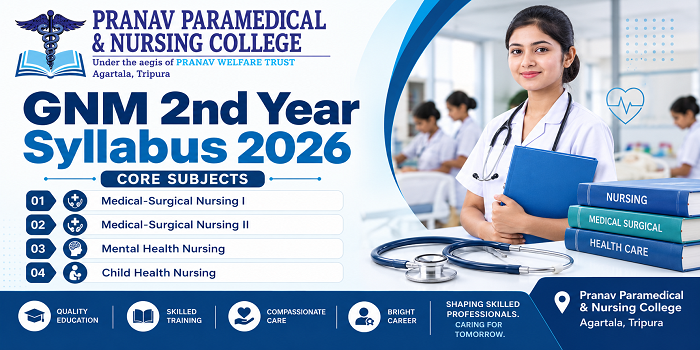
The GNM 2nd year subjects aim at improving the students’ knowledge regarding patient care and making them ready to assume more responsibilities in their clinical practice. The subjects usually include subjects such as medical-surgical nursing, mental health nursing, child health nursing, and community health nursing.
Professional skills differ from one subject to another. While medical-surgical nursing teaches the student about the care of patients with different health problems, mental health nursing is concerned with the care of patients with psychological problems. Child health nursing teaches about the health care of infants and children.
GNM 2nd Year Theory Subjects
The theoretical aspect provides students with the necessary scientific and professional knowledge needed to ensure safe nursing practice. Depending on the program implemented by the institution, students will learn theories related to adult, mental, child, and community health care.
Students should be mindful not only of definitions but also of nursing techniques, patient assessment, health education, prevention, communication, and care planning. Linking theory and reality is one way of enhancing learning and preparing for exams.
GNM 2nd Year Practical Subjects
Practical training is a vital component of the GNM second-year curriculum. The students have the chance to apply the classroom theories in the process of acquiring clinical skills.
Some of the practicals include patient assessment, taking vital signs, keeping nursing documentation, helping in treatment processes, infection control, health education, patient communication, and other clinical practices in nursing. It is important for students to adhere to the guidelines given by the clinical instructors.
Detailed GNM 2nd Year Syllabus
Medical-Surgical Nursing
Medical-surgical nursing is one of the most important topics for the GNM nursing because the students are introduced to the nursing care of patients suffering from different illnesses and surgical procedures. This topic includes data gathering from the patients, identification of the nursing problems, interventions, and changes in the health status, and interventions.
Some of the important topics that are supposed to be learned by the students are adult health problems, pre-and post-operative care, drug therapy, infection control, nutrition, pain management, patient education, and rehabilitation.
Mental Health Nursing
Mental health nursing makes students realize how to know more about mental well-being, mental disorders, behavior of patients, therapeutic communication, and the duties of the nurses within their practice.
They can learn how to deal with some mental disorders, what causes them, symptoms, treatment methods, observation of the patients, counseling principles, and rehabilitation. It is very important to show respect towards patients having problems with their mental health.
Child Health Nursing
Nursing care in childhood is concerned with the needs of infants, children, and teenagers physically, psychologically, and developmentally. In addition, it helps the students understand the differences between nursing care of children and nursing care of adults and the importance of family involvement.
Some of the subjects of nursing care in childhood that are covered in the second year of GNM include growth and development, nutrition, immunizations, diseases of childhood, disease prevention measures, pediatric hospitalization, and pediatric nursing care. Effective communication with children and their parents is important for the students.
Community Health Nursing
Community health nursing provides students with an introduction to the provision of care at the community level as opposed to learning about the health needs of individuals at the hospital level.
Students are introduced to families, population, health promotion, disease prevention, and public health services. Some of the topics that can be covered in this specialty include community health assessment, maternal and child health, environmental sanitation, nutrition, health education, prevention of communicable diseases, family health care, and community health workers.
GNM 2nd Year Clinical Training
Clinical training gives students an opportunity to link their theoretical knowledge with practical patient care scenarios. In their clinical postings, the learners have an opportunity to watch how professionals carry out their duties, thus gaining confidence in carrying out appropriate procedures.
The learners can get involved in different healthcare settings based on their institutions’ training programs. Clinical training involves observation, documentation, communication, nursing procedures, health education, and involvement in ward activities.
It is important for the learners to be punctual, maintain professional conduct, hygiene, patient confidentiality, accurate documentation, and effective communication during clinical training. The students must use instructors’ feedback to improve their nursing skills.
GNM 2nd Year Exam Pattern
The exam pattern for the 2nd year GNM is based upon the curriculum and the rules that are applicable to the respective institution and nursing board. Examinations consist of theory as well as practical assessment.
Students should refer to the most recent notification issued by their college regarding exam dates, subjects, marking scheme, eligibility criteria, practical assessment, and pass criteria. Students should not rely on old notes and information from the previous batches; instead, they should refer to the most recent syllabus and instructions issued by their institution.
Important Topics to Prepare for GNM 2nd Year Exams
Preparation should begin with an understanding of the syllabus and not just with random revision. What this means is that the students should know the key areas in each subject and be given time to study them.
There should be a specific focus on disease conditions, symptoms and signs, nursing management, prevention, education of patients, clinical procedures, psychology, child development, community health care, and other key areas that have been stressed by the lecturers.
Writing down brief revision notes, solving examination questions, going through clinical procedures, and reviewing topics regularly will help improve your preparation. It should also be mentioned that the students should be clear about concepts owing to application-based questions.
How to Prepare for GNM 2nd Year Exams
Definitely, a good study habit will make the syllabus for GNM 2nd-year easier for you. Start with the timetable for each subject and break up big topics into small parts. Plan time for revising the theory as well as developing the skills.
The students can refer to books recommended by the college in addition to lecture notes, clinical notes, and other study materials. If there is any disease or illness, try to know about the cause, signs and symptoms, diagnosis, and management of the same.
Revision should be done on a regular basis rather than cramming at the last moment; the revised part should be covered on a weekly basis. The queries or confusion related to difficult subjects can be sorted out by discussing the topic with the teachers as well as with fellow students. Most importantly, it is necessary for the students to adhere to the latest academic regulations of their college.
Career and Academic Opportunities After GNM 2nd Year
By the completion of the second year, the student would be well prepared to take up the subsequent years in GNM education. The knowledge gained during this duration would play an important role in the development of professional nursing skills.
After successful completion of the GNM program and registration, one would be able to search for nursing-related careers in hospitals, health care centers, nursing homes, and various other institutions. Career progression depends on qualifications, registration, experience, skills, and employer’s requirements.
Those intending to continue their education in the future would have the option of various nursing programs after GNM.
Why Choose Pranav Paramedical & Nursing College for GNM Nursing?
Choosing the correct institute is one of the key aspects that students looking towards nursing have to focus on. Pranav Paramedical & Nursing College takes pride in providing quality nursing education through academics, skills, and professionalism.
When it comes to the GNM students, theoretical knowledge is required to be supported by clinical knowledge and professionalism. There are a number of things, such as curriculum, faculty assistance, practical knowledge, learning environment, facilities, etc., that students must take into consideration while selecting the institute.
The students who wish to enroll in the institute should contact Pranav Paramedical & Nursing College in order to get relevant information regarding GNM admissions, eligibility criteria, fees, etc.
Conclusion
GNM 2nd Year Syllabus is highly beneficial in gaining the required knowledge and skills to get the best possible education in the field of nursing. Subjects that relate to adult health, mental health, child health, and community health nursing provide the opportunity to students to learn about caring for patients from different perspectives.
For attaining success in the second year of learning, the learner requires conceptual understanding, revision, practice, and professional behavior. The application of the latest syllabus, following the academic guidelines of the educational institution, and continuous effort in theoretical and practical knowledge will ensure success.
1. What subjects are included in the GNM 2nd year?
The curriculum generally covers important nursing areas such as medical-surgical nursing, mental health nursing, child health nursing, and community health nursing, along with practical and clinical learning as applicable to the current curriculum.
2. Is GNM 2nd year difficult?
The second year can be academically demanding because students study more specialized nursing concepts and develop clinical skills. Regular study, revision, practical practice, and guidance from teachers can make the curriculum easier to manage.
3. Does the GNM 2nd year include practical training?
Yes, practical and clinical learning is an important component of GNM education. Students apply theoretical knowledge in appropriate healthcare settings under supervision according to their institution’s training requirements.
4. How should I prepare for GNM 2nd-year exams?
Begin with the current syllabus, prepare a realistic timetable, understand important concepts, revise regularly, practice examination questions, and connect theoretical learning with clinical situations.
5. Where can I find the GNM 2nd-year syllabus?
Students should first check the latest curriculum and academic instructions issued by their nursing institution or applicable nursing education authority. This helps ensure that they are preparing according to the current requirements.

Pranav Paramedical


Working Time
- Mon - Sat : 09:00 AM - 06:00 PM
- Damdamia, Oppo. CJ Resorts, Debendra Chandra Nagar, P.O.- Lembucherra, P.S.- Lefunga, Agartala, West Tripura, Tripura- 799210.
Copyright © 2026, PPNC. All Rights Reserved.
WhatsApp us