
Blog Details
- Home
- Nursing Course Duration in India: B.Sc Nursing, GNM & ANM
- August 7, 2026
- comments (0)
- 10 min read
Nursing Course Duration in India: B.Sc Nursing, GNM & ANM
Selection of nursing as a profession starts right from the time one is in school, and one of the first things one wonders is the time it takes to complete the course. How many years does nursing take? The answer lies in the kind of nursing program you select because there are degree-level and diploma-level nursing programs.
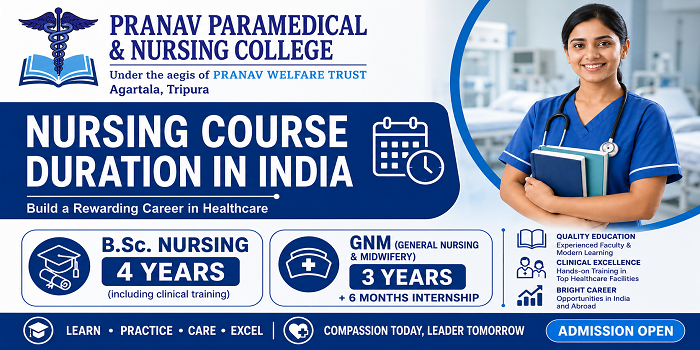
In general, the time taken to complete the nursing course differs from one nursing program to another. While B.Sc Nursing is the undergraduate nursing degree program, GNM and ANM nursing programs differ in terms of the duration they take to complete. This will go a long way in helping students pick the nursing program of their choice.
For those interested in a career in the healthcare field, Pranav Paramedical & Nursing College offers an environment conducive to learning nursing.
Nursing Course Duration in India at a Glance
The duration of nursing programmes differs according to the level and type of qualification. The commonly pursued programmes include B.Sc Nursing, GNM and ANM.
Nursing Programme | Typical Duration | Qualification |
B.Sc Nursing | 4 years | Undergraduate degree |
GNM Nursing | 3 years | Diploma |
ANM Nursing | 2 years | Diploma |
These time periods reflect the structure usually followed by the particular program. But before admission, students need to check the requirements for the particular course from the particular university or educational establishment and the related regulatory body.
Consequently, there is no one solution to the question “How long does it take to become a nurse?” It all depends on the selected program and chosen career path.
B.Sc Nursing Course Duration
The period for B.Sc Nursing is usually four years. It is an undergraduate degree in nursing that is intended to give students an education that combines theory, lab work, and practice.
In this course, students will learn about different topics related to nursing science, biology, community health, and caring for patients. This curriculum is meant to slowly build the academic and nursing skills of the students.
What Do Students Study During B.Sc Nursing?
Some topics that may be covered in a B.Sc. Nursing course would include:
- Anatomy and Physiology
- Fundamentals of Nursing
- Nutrition and Dietetics
- Psychology
- Pharmacology
- Medical-Surgical Nursing
- Community Health Nursing
- Child Health Nursing
- Psychiatric Nursing
- Obstetrics & Gynecological Nursing
- Nursing Research
- Nursing Management
Of course, this may vary depending on the particular regulations followed by the program.
Why Does B.Sc Nursing Take Four Years?
However, it is not all about classwork in nursing. It is imperative to provide opportunities where students can obtain clinical experience, interpersonal skills, and professionalism.
Students will take four years to go from basic concepts to advanced nursing concepts through clinical exposure. Clinical exposure is fundamental in the application of theoretical concepts by students.
GNM Nursing Course Duration
The Length of the GNM programme is usually three years, based on the programme structure which is most often used. The GNM programme covers nursing, patient care, community health, and midwifery studies.
GNM students get educated in basic and intermediate nursing care as well as development of professional skills.
What Do GNM Students Learn?
GNM syllabus may include topics such as:
- Nursing fundamentals
- Med-Surg nursing
- Community health nursing
- Child health
- Mental health
- Maternal health
- Midwifery
- Nutrition
- First aid
- Health education
- Nursing procedures
Practical learning is an essential part of nursing studies. It is necessary for students to know about proper performance of nursing procedures and collaboration within healthcare teams.
Clinical Training During GNM
Clinical training allows the students to connect theory to practice in the health-care setting. The students will get to learn different clinical areas based on the program and the institution.
The practical part is meant to develop self-confidence, professionalism, communication skills, and patient care skills.
ANM Nursing Course Duration
The course for ANM Nursing takes around two years to complete. Auxiliary Nurse Midwifery is a diploma course, which provides training in basic nursing practice, maternal and childcare, community healthcare, and health education.
The Auxiliary Nurse Midwifery course could be of great relevance to students who have an interest in basic healthcare services.
What Is Taught in ANM?
Some of the topics that the learner may be interested in include:
- General nursing care
- Community health
- Maternal health
- Child health
- Nutrition
- First aid
- Health education
- Hygiene and sanitation
- Principles of primary health care
This course consists of both theoretical and practical classes whose objective is to train the learners in basic health care responsibilities.
Due to the variations in the course curriculum, learners are advised to obtain details about the latest curriculum from their institutions.
Nursing Course Duration After 12th
Many different nursing courses are offered by many nursing colleges to students after completing their 12th standard.This will totally depend on the qualifications of the students, eligibility requirements, and the qualification which they desire to gain.
For example, if a student desires to gain his/her bachelor’s degree, he/she must join a B.Sc Nursing course, while those who want to pursue their career through diploma courses may prefer joining a GNM or ANM course.
In such a manner, there are many different nursing courses after completing class 12th. However, joining a short course alone will not suffice, since there are many other considerations as well.
B.Sc Nursing vs GNM vs ANM: Duration Comparison
Understanding the difference between nursing courses is easier when their duration and qualification levels are compared together.
Feature | B.Sc Nursing | GNM | ANM |
| Level | Degree | Diploma | Diploma |
| Typical duration | 4 years | 3 years | 2 years |
| Focus | Comprehensive nursing education | Nursing and midwifery | Basic nursing and community health |
| Practical learning | Yes | Yes | Yes |
| Academic pathway | Undergraduate degree | Diploma pathway | Diploma pathway |
The duration is only one factor when selecting a nursing programme. Students should also examine the academic level, curriculum, clinical exposure and possibilities for further education.
What Factors Can Affect Nursing Course Duration?
There is usually a pre-existing system regarding how the program will proceed; however, students must not assume that all institutions operate on the same academic calendar.
The following could be some of the things that may have an effect on the successful completion of the program:
- Current education laws and regulations
- Requirements by the university or exams
- Clinical requirements
- Academic progress
- Practical/Internship requirements
- Policy of the institution
- Change in education laws and regulations
Therefore, it is crucial that the duration of the nursing program be determined before any decision is made concerning the education process.
This is because the nursing program requirements may be changed at any time.
Does Nursing Course Duration Include Clinical Training?
Clinical training is a vital part of nursing training. Nevertheless, it is necessary for students to differentiate between classroom training, laboratory training, and clinical training.
The structure of a typical nursing course includes:
Theory → Lab Practice → Clinical Training → Professional Training
Classroom training forms the theoretical basis. In the laboratory, students are able to practice in a controlled learning environment, while in the process of clinical training, they learn about patient care in a real medical environment.
Thus, for future students, the amount and quality of practical training may matter as much as the duration of the course itself.
Which Nursing Course Should You Choose Based on Duration?
The right programme depends on the student’s educational objective rather than duration alone.
If You Want a Nursing Degree
B.Sc Nursing may be appropriate for students seeking an undergraduate nursing qualification and a broader academic foundation.
If You Prefer a Diploma-Level Nursing Programme
GNM provides a diploma-level nursing pathway with education in nursing care and midwifery.
If You Are Looking for a Shorter Nursing Programme
Despite having a shorter course, students should analyze the qualification, curriculum, eligibility criteria, and the education options in the future before making any decisions.
Not always will the shortest course be the best course to go for. It all depends on what you want your nursing career to be.
What Happens After Completing a Nursing Course?
Graduation from a nursing program can result in several educational and career options depending on the degree achieved and one’s career objectives.
Possible career options could be:
- Practice in the healthcare field
- More education in nursing
- Specializations in nursing
- Education qualifications
- Community healthcare
- Nurse practitioner jobs in hospitals
- Preparation for competitive exams
One should remember that there are different job, registration, and recruitment requirements depending on the position, company, state, and so forth.
What Should Students Check Before Choosing a Nursing Course?
Before selecting a program, there are some factors that must be kept in mind by students other than the duration of the nursing program:
Factors of consideration:
Recognition/Association: Get assured about recognition and association of the college.
- Education Curriculum: Find out about the subjects and curriculum of education.
- Practical exposure: Get familiar with the practical exposure available to the students.
- Faculty members: Check their credentials and knowledge.
- Laboratories for practical training: They can be helpful in gaining skills.
- Academic environment: A positive one can help in personal development of the learners.
- Future education: Plan ahead of time and see the utility of the qualification in fulfilling your objectives.
- Eligibility Criteria: Find out the latest eligibility criteria for the program.
The students at Pranav Paramedical & Nursing College get an opportunity to study nursing education through an academic perspective.
Final Takeaway
The time period of the nursing course is the first basic piece of information that every nursing student needs to have in mind while planning for his/her career in the health care profession, but at the same time, only the duration of the nursing course cannot be considered by nursing students while choosing to go for a nursing course. The differences in terms of eligibility criteria, curriculum, training, and even future educational possibilities exist among B.Sc. Nursing, GNM, and ANM.
In order to choose a nursing course, students need to consider the syllabus, objectives, clinical practice, facilities of the institute, and existing regulations for the particular programme. This will help students to choose the right nursing path according to their educational and career goals.
Students who are in search of nursing education can consider Pranav Paramedical & Nursing College as part of their research on nursing education and nursing training.
1. How many years is a nursing course?
The duration depends on the programme. B.Sc Nursing is generally four years, while GNM and ANM have shorter diploma-level programme structures.
2. How long is B.Sc Nursing?
The B.Sc Nursing course duration is generally four years for the undergraduate programme.
3. How long is GNM Nursing?
The commonly followed GNM Nursing duration is three years.
4. How long is ANM Nursing?
The ANM Nursing duration is generally two years.
5. Which nursing course is the shortest?
Among the commonly discussed B.Sc Nursing, GNM and ANM pathways, ANM has the shortest typical duration. Students should still compare qualification level and career objectives before choosing.
6. Can I study nursing after Class 12?
Yes, students can explore nursing programmes after Class 12, provided they meet the current eligibility requirements for the programme and institution they choose.
7. Is B.Sc Nursing longer than GNM?
Yes. B.Sc Nursing generally has a four-year undergraduate structure, while GNM is generally a three-year diploma-level programme.

Pranav Paramedical


Working Time
- Mon - Sat : 09:00 AM - 06:00 PM
- Damdamia, Oppo. CJ Resorts, Debendra Chandra Nagar, P.O.- Lembucherra, P.S.- Lefunga, Agartala, West Tripura, Tripura- 799210.
Copyright © 2026, PPNC. All Rights Reserved.
WhatsApp us