
Blog Details
- Home
- Top 5 Paramedical Courses After 12th: Duration & Career Scope (2026 Guide)
- August 1, 2026
- comments (0)
- 11 min read
Top 5 Paramedical Courses After 12th: Duration & Career Scope (2026 Guide)
If you’ve just finished Class 12 and you’re scrolling through career options at 1 a.m. wondering whether medicine is really the only respectable path in healthcare — take a breath. It isn’t. Every hospital you’ve ever walked into runs on a small army of trained professionals who aren’t doctors at all. They’re paramedical staff, and India needs a lot more of them.
At Pranav Paramedical & Nursing College (PPNC) in Agartala, Tripura, we meet hundreds of students every admission season asking the same question: “Sir, which paramedical course should I actually choose?” So instead of another generic listicle copied from ten other websites, this guide walks you through the top 5 paramedical courses after 12th — what they actually involve, what they cost, how long they take, and what kind of job and salary you can realistically expect once you’re done.
We’ve written this from the perspective of an actual nursing and paramedical training institute, not a content farm guessing at syllabus details from the outside. Everything here reflects what our faculty and admission counsellors see year after year in classrooms, hostels, and hospital wards alongside our own students.
What Are Paramedical Courses?
Paramedical courses refer to the diploma or degree programs that prepare students to assist doctors and specialists in providing medical treatment without the need for an MBBS degree. Consider laboratory technicians, nurses, OT assistants, radiography technicians, physiotherapists, etc. These people play an important role in any working hospital, and the demand for such individuals has increased with the development of the healthcare sector in Tier-2 cities such as Agartala in India.
Why Paramedical Courses Are in High Demand Today
India’s healthcare sector is short-staffed at almost every level, not just doctors. Government health missions, private hospital chains, and even overseas healthcare systems are actively recruiting trained paramedical and nursing professionals. Unlike an MBBS, which takes 5.5 years plus specialization, most of these programs get you job-ready in 1 to 4 years — which is exactly why so many students are choosing this route straight after school.
New hospitals, diagnostic centres, and clinics are opening every year, even in smaller cities and towns across states like Tripura, Assam, and the wider Northeast — and every single one of them needs trained hands on the ground, not just qualified doctors sitting in consultation rooms.
Why Choose a Paramedical Course After 12th?
If you enjoy science, want financial independence early, and would rather start earning while your MBBS-aspirant friends are still studying for NEET re-attempts, paramedical education is worth serious consideration.
Career Stability and Job Security
Healthcare, unlike many other industries, rarely goes through hiring freezes. Hospitals — government and private — need trained staff every single year, which makes these roles some of the most recession-proof careers available to a 12th-pass student. Even during economic slowdowns, patients keep needing care, and that steady demand rarely disappears.
Shorter Duration Compared to Medical Degrees
Most paramedical diploma courses after 12th run between 1 and 3 years, and even the degree-level options (like B.Sc Nursing) wrap up in 4 years — a fraction of the time a full medical degree demands, letting you enter the workforce and start earning much sooner. For many families, that shorter timeline also means a lighter financial burden overall, since fewer years of tuition and hostel costs are involved.
Eligibility Criteria for Paramedical Courses After 12th
Before picking a course, it helps to know what doors are actually open to you based on your stream and marks.
Subject Requirements (Science Stream/PCB)
Most reputed paramedical courses after 12th science require Physics, Chemistry, and Biology (PCB) as compulsory subjects. Courses like GNM are slightly more flexible and accept students from other streams too, provided English was a subject in Class 12. This flexibility is one reason GNM remains such a popular entry point for students who didn’t take science in Class 11 and 12 but still want a career in healthcare.
Minimum Percentage & Age Limit
Typically, a minimum of 40–45% in the qualifying exam is required (with relaxation for reserved categories), and candidates should generally be between 17 and 35 years old at the time of admission — though this varies slightly by course and institute. It’s always worth checking the exact eligibility criteria on the specific college’s admission page before you rule any option out, since small variations between states and institutes are common.
Top 5 Paramedical Courses After 12th
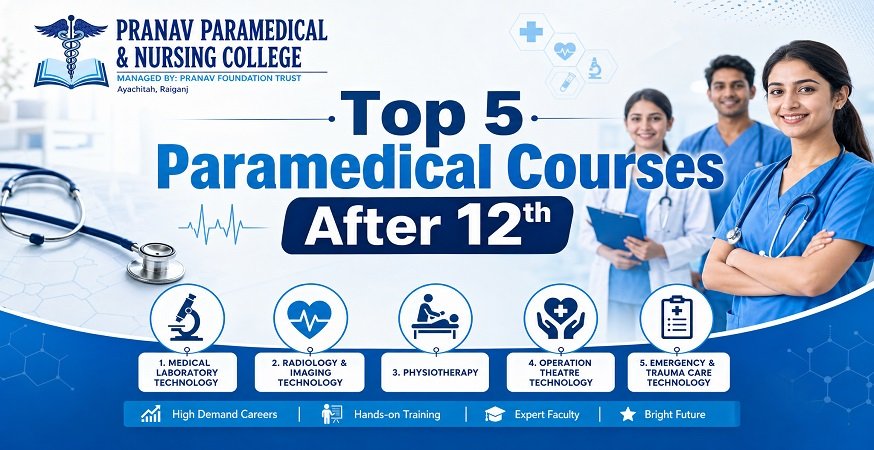
Here’s our shortlist — based on genuine placement trends, affordability, and long-term career scope — of the best paramedical courses after 12th you should be considering right now.
1. GNM (General Nursing & Midwifery)
The GNM Diploma Program is a three-year-long program (and six months internship), where the students are taught to become proficient in patient care, community health work, and midwifery. This is considered to be one of the most easily accessible paramedical diploma programs after 12th standard and is available for any stream of students.
2. B.Sc Nursing
For those who seek higher education qualifications that can provide them with long-term growth, B.Sc Nursing is the best course available in the market as it is a four-year course that includes all aspects of clinical and hospital administration knowledge, and specialization courses as well. The job prospects include Registered Nurse and Nurse Educator among others.
3. Diploma in Medical Laboratory Technology (DMLT)
DMLT usually consists of a 1-2-year program centered around the collection of samples, laboratory tests, and diagnosis. Since diagnosis chains are increasing rapidly all over India, there is always a high demand for lab technicians. This is one of the more underrated programs in this list for those who like working in labs rather than interacting with patients.
4. Operation Theatre Technology (OTT)
This course trains students to assist surgeons inside the operation theatre — managing equipment, sterilization, and surgical support. OTT is usually a 2-year diploma and tends to have strong placement rates in multi-specialty hospitals, since every OT needs trained technicians on every shift.
5. Radiology / X-Ray Technician Course
A radiology technician operates X-ray, CT, and MRI machines under a radiologist’s supervision. This 1–2 year diploma course is compact, technical, and consistently in demand — diagnostic imaging is one department that simply cannot function without trained technicians.
Comparison Table
Here’s a simplified side-by-side look to help you compare these five options at a glance.
| Course | Duration | Entry Stream | |
| GNM | 3 Years + 6 Months Internship | Any Stream | |
| B.Sc Nursing | 4 Years | PCB Mandatory | |
| DMLT | 1–2 Years | Science Preferred | |
| OTT | 2 Years | Science Preferred | |
| Radiology Technician | 1–2 Years | Science Preferred |
Fee ranges vary by institute and state — always confirm current figures directly with the college you’re applying to.
Which Course Costs the Least?
However, DMLT and Radiology Technician programs are the most affordable in terms of both fees and time required to complete the program, thus appealing to those who wish to begin earning quickly without spending too much money.
Which Course Has the Shortest Duration?
Similarly, the duration of the DMLT and Radiology Technician course is also very short, that is, just one to two years, while for GNM and B.Sc. Nursing, it takes longer but offers more career prospects as well.
Career Scope & Salary After Paramedical Courses
The real question every student (and every worried parent) eventually asks is: will this actually pay off?
Government Job Opportunities
GNM and B.Sc Nursing graduates get recruited into various government hospitals, community health centers, ESIC, railways, and defense health departments. Lab and radiology technicians find ample employment opportunities within government diagnostic laboratories. Recruitment by government sectors usually comes with certain perks like job security, pension schemes, and pay scale, among others, and this is the reason why competition for such posts is high.
Private Hospital & Clinic Opportunities
Private multi-speciality hospitals, diagnostic centres and nursing homes have been recruiting in all the above five courses regularly, and sometimes their recruitment process is even faster than the government one. Some private recruiters even prefer applicants who have practical experience; hence, that is the reason why practical clinical training in your course is as important as your marksheet.
Salary Range for Freshers vs Experienced
Fresh GNM/DMLT graduates earn a starting salary of about ₹12,000-20,000 a month depending on their experience and jobs in government institutions, while fresh B.Sc Nursing graduates earn a little bit more and see good salary increments in the coming 5-10 years when they take up supervisory positions or specialized positions in nursing. OTT/radiology technicians fall in the same category of earning the same starting salary.
Skills You’ll Need to Succeed in These Careers
Apart from marksheets and degrees, there are some skills that play a crucial role after you step into the practical world. These include qualities like patience, paying attention to details, handling pressure, and having excellent communication skills because these factors have as much importance in the lab or operation theatre as they have at the bedside of the patients. It will not only help you maintain coordination with the other professionals in the field but also with the anxious relatives of the patient. And all these qualities cannot be developed by studying from textbooks but by gaining practical experience and working in the hospitals during your course.
Paramedical Courses vs Nursing: Which Should You Choose?
This is genuinely one of the most common dilemmas we see at Pranav Paramedical & Nursing College.
Key Differences in Curriculum
The nursing course (GNM & B.Sc Nursing) includes a large amount of practical learning related to patient care and clinical work. Other paramedical courses such as DMLT, OTT, and Radiologist include more technical studies and laboratory procedures with limited patient involvement.
Which Path Offers Better Long-Term Growth?
There will be more variety within the nursing career path compared to the paramedical one with regard to future career choices since there is scope in nursing for supervision posts, teaching, management, and even international postings. However, it is up to individual choice whether the student prefers being a nurse or a paramedic.
How to Get Admission Into a Paramedical Course
Once you’ve picked your course, the admission process itself is fairly straightforward if you keep your documents ready in advance.
Documents Required
Most institutes, including PPNC, require your 10th and 12th mark sheets, transfer certificate, migration certificate (if applicable), Aadhaar card, passport-size photographs, and a basic medical fitness certificate.
Entrance Exams (if applicable)
B.Sc Nursing admissions often require NEET-UG, a state-level entrance exam, or CUET, while GNM and most diploma-level paramedical courses are largely merit-based, without a mandatory entrance exam.
Conclusion: Choosing the Right Paramedical Path for You
Among all the five careers described above, there is nothing like ‘the best choice’, but rather, there is always ‘the best answer’ for every individual, taking into consideration their preferences, budgets, and the time they need to begin their job immediately after education. If you prefer patient care and are looking forward to developing a rewarding career, GNM or B.Sc Nursing would be the right choice for you.
If you are more interested in technical or laboratory careers and have less time to pursue a course of study, then DMLT, OTT, and Radiology Technician could be considered for you. Whatever your choice is, choose an institute where practical training is as important as your academic learning. In Pranav Paramedical & Nursing College, Agartala, GNM and B.Sc Nursing courses have been designed considering just that.
1. Which paramedical course has the highest salary?
Of all the subjects mentioned above, B.Sc Nursing is known to have the most substantial salary progression over a lifetime, particularly with government placements, specialization, or foreign placements.
2. Can I do a paramedical course without NEET?
Yes — GNM, DMLT, OTT, and Radiography Technician do not need NEET; it’s only B.Sc Nursing admission where NEET is needed.
3. Which is better — paramedical or nursing?
It depends on your interest: choose nursing for direct patient care and long-term career growth, or a technical paramedical course if you prefer lab, surgical, or diagnostic support work.
4. What is the duration of paramedical courses after 12th?
Duration ranges from 1–2 years for diploma courses like DMLT and Radiology Technician, up to 3 years (plus internship) for GNM, and 4 years for B.Sc Nursing.

Pranav Paramedical


Working Time
- Mon - Sat : 09:00 AM - 06:00 PM
- Damdamia, Oppo. CJ Resorts, Debendra Chandra Nagar, P.O.- Lembucherra, P.S.- Lefunga, Agartala, West Tripura, Tripura- 799210.
Copyright © 2026, PPNC. All Rights Reserved.
WhatsApp us