
Blog Details
- Home
- Diploma vs Degree in Nursing: Key Differences, Career Scope, Eligibility, Salary & Which One Is Right for You?
- July 14, 2026
- comments (0)
- 13 min read
Diploma vs Degree in Nursing: Key Differences, Career Scope, Eligibility, Salary & Which One Is Right for You?
Introduction
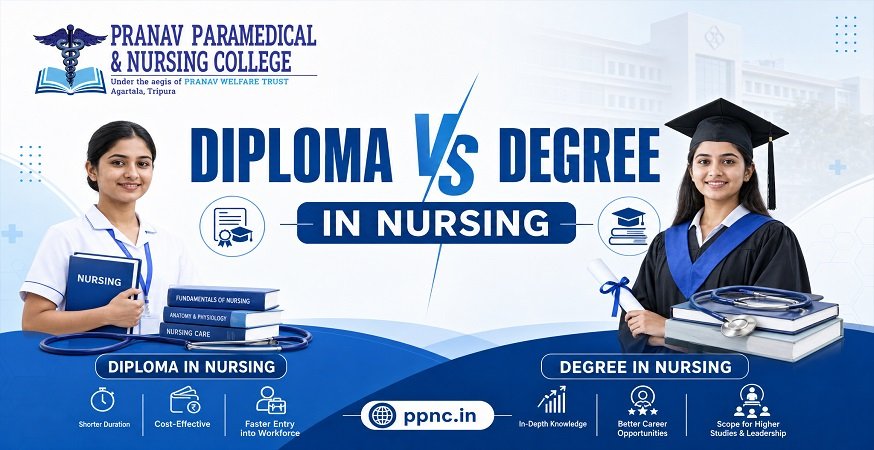
Selection of a course in nursing is a major factor for students who want to establish themselves as successful professionals in the field of healthcare. Two popular courses that a student has after 12th grade are a Diploma in Nursing and a Degree in Nursing. Though both courses enable students to provide service to patients and make contributions to the healthcare system, both courses are different in many aspects, such as syllabus, duration, career options, salary packages, and professional growth. Comparison of a Diploma vs Degree in Nursing will give students a better understanding while making the choice.
There is an increasing demand for skilled nurses across India as well as abroad because of the development of the healthcare sector, the increase in the number of aged people, and the increased concern for good care of patients. Be it a diploma or degree in nursing, students can have a rewarding career ahead of them.
In Pranav Paramedical & Nursing College, students get a good quality education, clinical exposure, and professional guidance to make their careers in nursing a success. This guide discusses everything you should know about a Diploma vs. Degree in Nursing, such as eligibility, syllabus, career prospects, salary, and much more.
What Is a Diploma in Nursing?
A Diploma in Nursing is a vocational healthcare program that seeks to equip students with the basic knowledge and necessary skills needed for patient care. Diploma nursing programs emphasize clinical training, thus equipping students with the skills needed for effective work in hospitals, clinics, nursing homes, and community-based healthcare.
Some of the diploma-level nursing courses offered in India include General Nursing and Midwifery (GNM) and Auxiliary Nursing and Midwifery (ANM). These courses cover topics such as patient care, maternal care, emergency care, infection control, and general medical practices.
The period of study in the diploma nursing programs varies between two and three and a half years, depending on the course. Candidates who have attained their secondary level education from a recognized board can enroll in these programs.
The biggest advantage of a diploma program is the fact that one can start working within a short time. This is because the syllabus concentrates a lot on practical training; hence, the students are well-equipped to deal with practical scenarios right from when they get into work.
Diploma course students also benefit from the experience gained through internship and hospital training, which enables them to develop communication and professional ethics necessary for nursing practice.
What is a Degree in Nursing?
Bachelor of Science in Nursing (B.Sc Nursing) is a four-year program that provides education, training, and practical experience to make students eligible for professional nursing. The degree in nursing is different from the diploma in nursing in terms of having a wide range of academics and training for advanced nursing practice and management.
The main subjects covered in B.Sc Nursing are:
- Anatomy & Physiology
- Microbiology & Pharmacology
- Medical Surgical Nursing
- Community Health Nursing
- Pediatric & Psychiatric Nursing
- Nursing Research
Hands-on experience will be gained by students in the form of hospital postings, lab classes, simulation-based learning, and community health care programs. It helps in developing skills in clinical practice, thinking, communication, and ethical decision-making.
There are many other avenues for further studies, like M.Sc Nursing and certifications, which will also provide opportunities in hospitals, educational institutions, Government health care departments, Research centers, and foreign health care systems. At Pranav Paramedical & Nursing College, students get industry-specific education and training for their nursing profession.
Diploma vs Degree in Nursing – Understanding the Key Differences
When comparing a Diploma vs a Degree in Nursing, students should evaluate several important factors beyond course duration. The right choice depends on career objectives, educational interests, financial planning, and future aspirations.
Eligibility Criteria
The entry requirements to enroll in the two programs may vary slightly. Diploma programs have relatively easier entry requirements compared to degree programs, where there is a need to perform highly academically in science subjects like Physics, Chemistry, and Biology.
Those who intend to pursue further education or careers in advanced nursing find a degree program better.
Course Duration
The duration of a diploma is shorter than that of a degree program. This gives an opportunity for students to start working early on in life. Diploma programs normally take three years and cover more theoretical learning.
While the degree course takes about four years to complete, it offers more academic knowledge and practical skills.
Curriculum and Learning Approach
One of the biggest differences between Diploma vs Degree in Nursing is the curriculum offered.
In diploma courses, there is more focus on nursing practice, patient care at the bedside, and common clinical techniques. The students get involved in the hospital environment to learn from professionals.
In a degree course, there is an equal blend of theory, practice, research methodology, healthcare management, leadership, and evidence-based nursing practice.
Clinical Training
Both degree and diploma programs involve clinical experience. However, degree students are exposed to many more aspects of medicine, including medical departments, specialty health care units, outreach services, and nursing practices. Clinical exposure plays a significant role in developing important traits for a good nurse, such as decision-making, communication, teamwork, and patient-oriented care.
Career Opportunities After a Diploma in Nursing
Earning a Diploma in Nursing will provide you with plenty of entry-level jobs in the field of healthcare. As the diploma programs emphasize practice-oriented education, you’ll be ready for clinical jobs right after graduating. The Indian healthcare sector is growing rapidly; therefore, there’s a constant need for qualified nurses regardless of whether they work in rural or urban areas.
Graduates with this diploma can get hired at government and private hospitals, primary and community health centers, nursing homes, rehabilitation centers, diagnostic centers, NGOs, and home healthcare services. Additionally, many of them find themselves working at maternity units, emergency rooms, OPDs, and old age homes.
The first main advantage of selecting a diploma course is the early entry into the job market compared to degree courseholders. This could help those students who would like to earn money early or get practical experience early in life. Over the period of time, one can pursue further studies like a post-Basic B.Sc. Nursing to increase their credentials and careers.
In Pranav Paramedical & Nursing College, the diploma course students are exposed to much clinical practice and training, which helps them take care of health-related tasks in life.
Career Opportunities After a Degree in Nursing
A Degree in Nursing provides greater and more varied career choices due to the combination of practical skills with educational knowledge and leadership abilities. There is also the possibility of working in various professional positions within the health industry, whether in India or abroad.
Possible career options include Staff Nurse, Nursing Officer, ICU Nurse, Operating Theatre Nurse, Pediatric Nurse, Community Health Nurse, Public Health Nurse, Emergency Care Nurse, Clinical Instructor, Nursing Educator, Case Manager, and Hospital Administrator. A Degree in Nursing also opens doors to leadership positions.
Yet another benefit of pursuing a nursing degree is the possibility of having specialized departments like cardiologists, oncologists, nephrologists, critical care, psychiatry, orthopaedics, and neonatal ICU. Such fields usually offer career advancement and high pay.
The Degree in Nursing can further pave the way for postgraduate studies, research, teaching, and healthcare administration. Indian nursing degrees are accepted in many countries, opening up the prospect of overseas jobs for those eligible.
Quality education and experience with faculty and training in industry make Pranav Paramedical & Nursing College a college that can help students become successful nurses.
Salary Comparison: Diploma vs Degree in Nursing
Salary is one of the top considerations that people take into account while comparing a Diploma vs. a Degree in Nursing. Although the salaries vary according to different factors such as location, employer, specialization, and experience, it is true that the degree provides the greatest earning potential.
Diploma nurses usually start as beginner nursing jobs, and the salary increases progressively with the addition of more experience and certification. However, the degree holders might be able to apply for more varied nursing jobs and therefore earn more money.
Nurses who gain experience and have different qualifications, certifications, or post-graduation degrees can earn much more in the future. The nurses in specialties such as critical care, operating theaters, emergency medicine, and international health care systems get paid more than those in general nursing jobs.
Students must look at the long-term aspects such as specialization, promotion opportunities, etc., instead of thinking about only the initial salaries.
Higher Education Opportunities After Nursing
Learning is one of the values that the nursing profession upholds throughout a nurse’s life. Whichever route an individual chooses for studying, either with a diploma or a degree, many options exist for improving their qualification.
Those who have taken a diploma program have the option of joining a Post Basic B.Sc. Nursing course, which leads to obtaining a Bachelor’s degree in nursing. Those with degrees may proceed with M.Sc. Nursing, postgraduate diplomas, fellowships, and various nursing certifications such as critical care, oncology, neonatal nursing, psychiatric nursing, and emergency nursing.
Advanced studies in higher education provide avenues to specialize in other fields of nursing. These include education, administration of health institutions, public health, clinical research, and policy formulation.
Advantages of Choosing a Diploma in Nursing
Selecting a Diploma in Nursing may be one of the best choices for those interested in kickstarting their careers in a short time by getting practical experience.
These are some of the advantages:
- Shorter program length.
- Entry to the field of health care at an early age.
- Emphasis on bedside care.
- More affordable education route for most students.
- The chance to further one’s education in the future.
It is a good choice for those who like hands-on education and want to start working in the nursing field soon.
Advantages of Choosing a Degree in Nursing
Prospects of Having a Bachelor’s Degree in Nursing
The Degree in Nursing provides many advantages to those who wish to have wider prospects in their careers.
They are:
- Well-rounded theoretical and practical knowledge
- Higher chances of being eligible for governmental and nursing jobs
- Good chances of developing your career and becoming a leader
- Possibilities of pursuing further education and doing research work
- Recognition for working nationally and internationally
It is impossible to give a definite solution to the question of Diploma in Nursing vs Degree in Nursing because it depends on individual needs.
For instance, if your goal is to start working faster, get work experience, and reduce expenses, you can opt for the first one.
But if you are interested in career development, specialization, leading positions, education, and the global job market, getting a nursing degree can be more advantageous.
Other factors, such as personal preferences, budget planning, career prospects, learning possibilities, and quality of institution, should also be considered.
Choosing one of the reputable institutions, such as Pranav Paramedical & Nursing College, will guarantee high-quality education, qualified staff, practical training, and professional success, whatever degree you choose.
Common Myths About a Diploma and Degree in Nursing
There are many myths that affect students while choosing a nursing program. It is important to be aware of the reality in order to make sound decisions.
Myth: Diploma-qualified nurses do not have any career opportunities.
Reality: Those who hold diplomas can gain experience and go for further studies to advance their careers.
Myth: A nursing diploma ensures high salary packages immediately after graduation.
Reality: The salary package depends upon experience, specialization, employer, and professional skills as well as qualifications.
Myth: Diploma programs offer less practical exposure.
Reality: Diploma programs are very practical and emphasize gaining expertise in clinical skills.
Myth: Only those holding degrees qualify for government sector jobs.
Reality: The eligibility criteria differ based upon recruitment policies and qualifications.
Final Thoughts
When it comes to choosing between a Diploma vs Degree in Nursing, one should understand that both programs contribute significantly to making caring and well-educated healthcare workers. The first program is more accessible and practical, whereas the latter allows for acquiring extensive knowledge, career growth, leadership opportunities, and a chance to continue education.
The decision lies with each person, based on their goals, preferences, budget, and plans for further development. No matter what program a person chooses, all that matters is dedication, constant development, care, and professionalism.
In Pranav Paramedical & Nursing College, students get the chance to get high-quality education, up-to-date facilities, experienced professors, and practical training to achieve success in their careers in the field of healthcare.
1. What is the main difference between a Diploma and a Degree in Nursing?
A diploma primarily focuses on practical clinical training, while a degree combines theoretical education, research, leadership skills, and advanced clinical practice.
2. Which is better: a diploma or a degree in Nursing?
Both are valuable. A diploma is suitable for students seeking early employment, whereas a degree offers wider career opportunities, higher education pathways, and long-term professional growth.
3. Can diploma nursing students pursue higher education later?
Yes. Diploma holders can continue their studies through programs such as Post Basic B.Sc. Nursing and later pursue postgraduate nursing education.
4. Does a nursing degree provide better career opportunities?
Generally, yes. Degree holders often qualify for specialized clinical roles, administrative positions, higher education, and international employment opportunities.
5. Is there good career scope after completing a Diploma in Nursing?
Yes. Diploma graduates can work in hospitals, clinics, community health centres, nursing homes, rehabilitation facilities, and home healthcare services.
6. Why should students choose Pranav Paramedical & Nursing College?
Pranav Paramedical & Nursing College offers industry-focused nursing education, experienced faculty, practical clinical training, modern learning resources, and comprehensive student support to help aspiring nurses build successful healthcare careers.

Pranav Paramedical


Working Time
- Mon - Sat : 09:00 AM - 06:00 PM
- Damdamia, Oppo. CJ Resorts, Debendra Chandra Nagar, P.O.- Lembucherra, P.S.- Lefunga, Agartala, West Tripura, Tripura- 799210.
Copyright © 2026, PPNC. All Rights Reserved.
WhatsApp us