By the faculty team at Pranav Paramedical & Nursing College | Last updated: November 2026
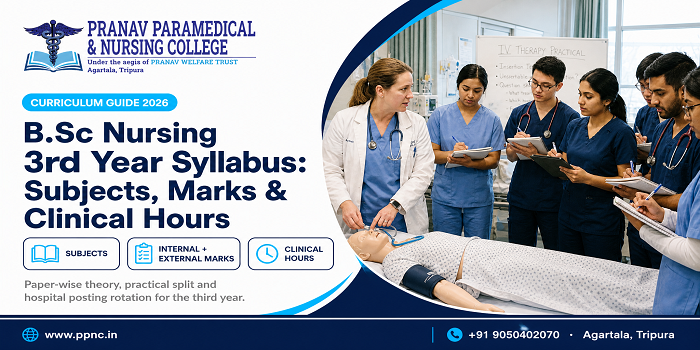
The third year is where nursing stops feeling like textbook learning and starts feeling like the real job. You move away from foundation sciences and into children’s wards, psychiatric units, community postings, and labour rooms. If you want to know what the B.Sc Nursing 3rd year syllabus covers, how marks are divided, and how many hours you will spend in hospitals, this guide explains it in plain language.
Quick Answer: B.Sc Nursing 3rd Year Subjects at a Glance
The third year is where nursing stops feeling like textbook learning and starts feeling like the real job. You move away from foundation sciences and into children’s wards, psychiatric units, community postings, and labour rooms. If you want to know what the B.Sc Nursing 3rd-year syllabus covers, how marks are divided, and how many hours you will spend in hospitals, this guide explains it in plain language.
B.Sc Nursing 3rd Year Syllabus 2026 as per INC
The BSc Nursing 3rd Year Syllabus 2026 follows the competency-based, credit-driven framework introduced by the Indian Nursing Council (INC). It focuses on what a nurse should be able to do at the bedside, not only on what she should know. Students who joined before the revision may still be on the older annual scheme, so ask your college which one applies to your batch.
Subject-Wise Syllabus Overview
Here is how each part of the B.Sc Nursing 3rd year syllabus breaks down, subject by subject, so you know what to expect before the semester begins.
Child Health Nursing Syllabus
The child health nursing syllabus, which BSc Nursing students study, begins with growth and development, then goes on to common childhood diseases, care of newborns, immunization, and nutrition. As per the old syllabus structure, this subject had 90 hours of theory and 270 hours of practical.
Mental Health Nursing Syllabus
The mental health nursing syllabus for BSc nursing programmes covers therapeutic communication, common psychiatric disorders, treatment approaches, and legal and ethical issues. The older scheme again allocates 90 theory hours and 270 practical hours, so expect plenty of time in psychiatric units.
Community Health Nursing Syllabus
The community health nursing syllabus for BSc Nursing includes epidemiology, environmental health, family health, and national health programmes. Students practise health education and home visits in real community settings.
Medical Surgical Nursing and Midwifery Syllabus
The syllabus for medical surgical nursing 2 is an advanced one from the second year with specialization in adults. With respect to the old system of learning, the course involves 120 hours of theory and 270 hours of practice. The syllabus for midwifery and obstetrical nursing involves antenatal, labour, postnatal, and neonatal nursing, with about 90 hours of theory.
B.Sc Nursing 3rd Year Clinical Hours & Practical Training
The B.Sc. Nursing 3rd-year clinical practice time takes up the major portion of the year. As per the old annual system, 990 out of the total 1480 hours are practical in nature. BSc Nursing 3rd-year practical courses are carried out via rotations at the pediatric ward, newborn nursery ward, psychiatry ward, field areas in the community, antenatal & postnatal wards, and labor rooms. Your college designs the BSc Nursing 3rd-year clinical posting timetable via the rotation scheme. Each unit in the BSc Nursing 3rd-year course syllabus corresponds to a specific ward exposure.
At Pranav Paramedical & Nursing College in Agartala, students reach government and multispeciality hospitals 2 to 12 kilometres from campus. That makes ward postings in child health, obstetrics and gynaecology, community health, ICU, NICU and emergency care easier to schedule.
Tips to Prepare for 3rd Year B.Sc Nursing
Once you have the B.Sc Nursing 3rd year syllabus in hand, plan your year around it:
- Revise second-year pharmacology and pathology early, since they support almost every third-year subject.
- Keep a ward diary of the cases you see each week.
- Practise nursing care plans for paediatric and psychiatric cases.
- Study clinical subjects in small daily blocks instead of cramming before exams.
Study B.Sc Nursing at Pranav Paramedical & Nursing College
If you are looking at BSc nursing colleges in Agartala, Pranav Paramedical & Nursing College offers hands-on training, labs, and hospital postings. Our team is happy to explain BSc nursing course details, eligibility, and the BSc nursing admission 2026 process. We also have separate hostels for boys and girls, which matters if you are searching for a BSc nursing college with a hostel in Tripura. For BSc nursing admission in Tripura, call +91 9050402070, Monday to Saturday, 9 AM to 6 PM.
Final Thoughts
The syllabus of BSc Nursing 3rd year acts as a connecting link between nursing studies and nursing practice. If you know the subjects, the marks distribution, and the number of clinical hours beforehand, then you can arrange your study schedule accordingly and go through the ward rotation as well as examinations without any hassle. Whichever curriculum your institute follows, make sure to use the syllabus of BSc Nursing 3rd year as a guide; read it before the commencement of every semester, check off the units done, and discuss your queries with the faculty.